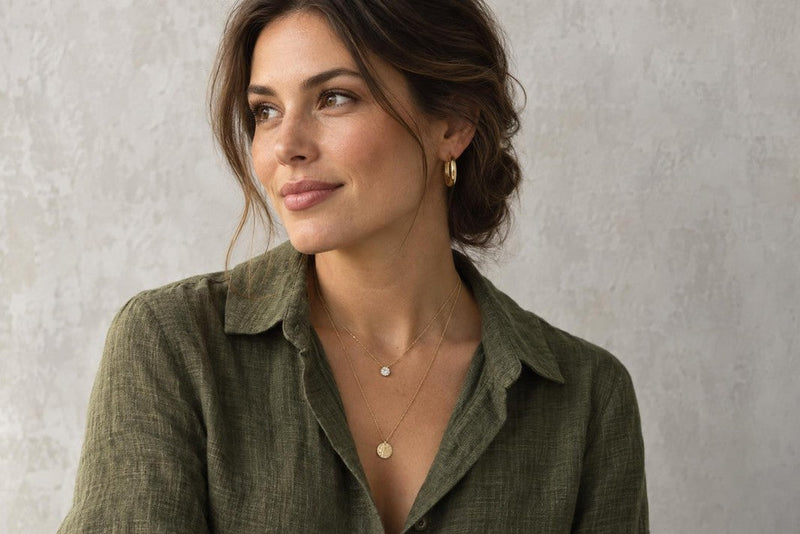
How to Style Gold Jewelry
Gold has a way of making decisions for you, and it is also the metal people second guess most. This guide shows how to read your undertone, why...


Gold has a way of making decisions for you. Put on a pair of yellow gold hoops and the rest of the outfit starts arranging itself around their warmth. The knit looks richer, the white shirt looks crisper, and the face looks more rested than it did five minutes earlier.
It is also the metal people second guess most. Is it too warm for my skin? Does 18k look different from 14k, and would anyone notice? Can a gold chain sit beside a white gold ring? How heavy should a chain be before it tips from polished into loud?
This guide answers those questions practically, beginning with the skin and ending after dark. None of it is a rule. All of it is a way of seeing gold more clearly, so that what you reach for in the morning feels chosen rather than habitual.
At a Glance
- Match the gold to your undertone, not your skin depth. The veins at the wrist and a white versus cream test tell you more than any label.
- Karat changes the color as much as the price. 18k reads deeper and more saturated, 14k a shade paler and tougher, 10k lighter again.
- Finish is a styling tool. High polish throws light, diamond-cut sparkles in motion, brushed gold reads calm and daytime.
- Layer by weight as well as length. One piece should be clearly heavier than the rest, so the look has a lead.
Start With the Skin, Not the Season
Every gold has a temperature. Yellow gold is warm and buttery, rose gold is warm with a blush of pink, and white gold is cool and bright. Skin has a temperature too. It sits beneath the surface color as an undertone, and it stays the same whether your complexion is fair, olive or deep.
The quickest test happens at the inner wrist, in daylight. Veins that look green suggest a warm undertone, blue or violet suggest cool, and a mix you cannot call either way usually means neutral. A second test uses fabric. Hold pure white and then soft cream beneath the chin. If cream flatters you and white looks stark, you lean warm. If white looks fresh and cream looks muddy, you lean cool.
Warm undertones glow in yellow gold, and richer karats make the most of it. Cool undertones are often told to avoid gold altogether, which is poor advice. The pink cast of rose gold flatters cool and pink-toned skin beautifully, and a paler 14k yellow sits far more easily than a deep 18k. Neutral undertones can wear all three, which is the best argument for owning more than one. If you are torn between the two warm golds, our comparison of yellow gold and rose gold walks through the choice.
Skin depth matters less than most people assume, though it does change the effect. On deep skin, polished yellow gold creates luminous contrast and reads rich rather than bright. On very fair skin, fine gold looks delicate, while heavier gold becomes a deliberate statement. Both are right. They simply say different things.
| Undertone | How to spot it | Gold to try first | Also works |
|---|---|---|---|
| Warm | Green veins; cream flatters more than white | 14k or 18k yellow gold | Rose gold, two-tone |
| Cool | Blue or violet veins; white flatters more than cream | Rose gold, white gold | Paler 14k yellow gold |
| Neutral | Veins hard to call; both whites look fine | Any of the three | Mixed tones in one look |
| Olive | Green-grey cast; brassy tones can look sallow | Rich yellow gold, rose gold | Brushed and satin finishes |
Featured from Sophia Jewelers
Two golds, two temperatures: a warm yellow hoop and a blush rose one


Karat Is a Color Decision Too
Karat is usually discussed as a question of value, but on the body it is a question of color. Pure gold is too soft for most jewelry, so it is alloyed with silver, copper and other metals. The more alloy a piece carries, the paler and harder it becomes.
18k gold has the deepest, most saturated yellow and a slightly heavier hand. It is gorgeous against warm and olive skin and at its best in pieces that see gentler wear, such as earrings, pendants and an occasion ring. 14k is the working karat. Its color is a shade lighter and a touch cooler, and the extra alloy makes it noticeably more resistant to scratches and dents, which is why it suits rings, chains and bracelets that are worn daily. 10k is paler again and the toughest of the three.
The styling point is this: pieces worn together look best when their karats are close. A deep 18k pendant beside a pale 10k chain can read as two different metals rather than one. If you are building a collection around a single gold, keep it within one karat step and let finish and texture create the variety. Our guide on how to choose gold jewelry goes further into weight, construction and hollow versus heavier links.
Polish, Texture and the Way Gold Meets Light
Two chains of identical karat and weight can look like entirely different jewelry depending on the finish. High polish gold works like a small mirror. It throws light back toward the face, photographs brightest, and carries a faint evening quality even at noon.
Diamond-cut gold is faceted with tiny angled planes, so it glitters as you move rather than shining in one sheet. That is why a diamond-cut rope or hoop can do the work of a gemstone. Brushed and satin finishes do the opposite. They soften reflection into a low glow that feels relaxed and modern against linen, denim and knitwear.
Mixing finishes is the most underused move in gold styling. A polished bangle beside a twisted one, or a brushed band beside a diamond-cut ring, gives the eye something to explore without introducing a second metal. It is how a single-gold look still feels layered and collected.
Gold rarely looks wrong. It only looks unconsidered, and the difference is almost always scale, finish and restraint.
Layering Gold by Weight as Well as Length
Most layering advice is about length, and length does matter. Chains spaced about two inches apart, such as sixteen, eighteen and twenty inches, will almost always sit cleanly, and our guide to layering necklaces covers the spacing in detail. With gold, weight matters just as much.
Choose one anchor that is clearly heavier than the rest, such as a rope, a curb or a paperclip link, and keep the others fine enough to read as accompaniment. Three chains of the same medium weight compete for attention. One bolder chain with two whisper-fine ones looks intentional.
The same logic holds at the wrist. A bangle with real presence and a delicate chain bracelet beside it will always look more considered than three bracelets of equal width. Let the textures talk to each other as well. A twisted rope beside a flat paperclip link sets up a contrast of form, while the shared gold keeps everything unified.
Featured from Sophia Jewelers
A fine chain, a flat link and a bangle with presence, for building gold by weight


What Gold Asks of Your Wardrobe
Gold changes character with what surrounds it. Against black it turns graphic, with every polished edge sharply drawn. Against navy it reads classic and a little nautical. Against camel, cognac, olive and chocolate brown it settles into a tonal richness that feels effortless, and this is where yellow gold looks most at home.
Crisp white shirting makes gold look bright and clean, while cream and ivory make it softer and more vintage. Jewel tones are natural partners. Emerald, sapphire blue and deep burgundy all deepen the metal and are deepened by it in return. Pale pastels deserve a lighter hand. Blush, lilac and powder blue are lovely with rose gold or finer yellow pieces, but a heavy chain can overwhelm them.
Let the neckline decide placement. A crew neck calls for a chain long enough to sit on the fabric, a V neck for a pendant that follows its point, and an open collar for a short chain resting at the base of the throat. With a high turtleneck, skip the necklace entirely and let hoops and a bracelet carry the look.
Gold Beside White Metals, Without the Worry
The old rule against mixing metals has quietly disappeared, and gold is the reason it never made much sense. Yellow and white gold have shared the same ring for generations, and the combination looks deliberate rather than accidental when it is handled with a little intention.
The easiest way in is a bridge, a two-tone piece that holds both colors and tells the eye the pairing is on purpose. A two-tone hoop, a white gold setting on a yellow band or a watch with mixed links all do this. Beyond that, keep the proportions uneven. Mostly gold with one cool accent, or the reverse, reads far better than an even split. Our mixing metals style guide covers the finer points.
Featured from Sophia Jewelers
A two-tone bridge for mixing, and a rose gold twist for the wrist


From the Morning Meeting to After Dark
At work, gold does its best in small, confident doses. Huggies or small hoops, a fine chain at the collar, a slim bangle or chain bracelet that stays quiet on a keyboard, and a single ring. Polished and brushed finishes both belong here, while heavy diamond-cut sparkle can feel insistent under office light. For a fuller edit, see our guide to jewelry for work outfits.
The evening shift is simpler than it looks, because you rarely need to change everything. Swap the huggies for a larger or diamond-cut hoop, add a second chain or a heavier anchor, and trade the slim bangle for something with more width. Gold responds beautifully to warm, low light, so pieces that seemed almost modest at noon begin to glow at dinner.
Then leave some space. The most common mistake with evening gold is a statement at every point, ears, throat, wrists and hands, all at once. Choose the one place that leads, and let everything else support it.
Frequently Asked Questions
Which gold color suits my skin tone?
Warm undertones usually shine in yellow gold, cool undertones in rose gold or white gold, and neutral undertones can wear all three. Check the veins at your inner wrist in daylight: green suggests warm, blue or violet suggests cool.
Can I wear gold and silver together?
Yes. Mixed metals look most intentional when one tone leads and the other accents it, and a two-tone piece helps bridge the two colors.
Is 14k or 18k gold better for everyday wear?
14k is the more practical choice for rings, chains and bracelets worn daily because it resists scratches and dents better. 18k has a deeper color and suits earrings, pendants and pieces that see gentler wear.
How many gold pieces should I wear at once?
There is no fixed number. A reliable approach is to let one area lead, such as the ears, the neck or the wrist, and keep everything else lighter so the look has a clear focus.
Does gold jewelry look good with black clothing?
Very much so. Black makes gold look graphic and sharply defined, which is why polished yellow gold hoops and chains are such a strong pairing with a black knit or dress.
Wear It Until It Looks Like Yours
The best gold styling rarely looks styled. It looks like pieces chosen for the person wearing them, in the right warmth and at the right weight, worn often enough to become part of how she moves. Start with the gold that flatters your undertone, keep your karats close, play with finish and weight, and let one piece lead at a time.
Explore our 14k gold selection and our earrings to find the pieces that begin your own way of wearing it.
Gold that answers to the way you dress.
Explore Gold Jewelry →