What Is Gold Filled Jewelry? The Thick Gold Layer Behind the 14/20 Stamp
Gold filled jewelry has no gold filling. It is a base metal core with a thick layer of karat gold bonded to the outside, at least 1/20 of...

Turn a gold filled chain over near the clasp and you may find a stamp so small it takes good light to read: 14/20. Those few characters hold most of what you need to know about the piece, and hardly anyone explains them at the counter.
Gold filled jewelry is a base metal core, usually brass, with a thick layer of karat gold bonded to the outside by heat and pressure. To carry the name under US guidelines, that layer must be at least 10K gold and at least 1/20 of the total metal weight.
It outlasts ordinary plating by a long way and costs far less than karat gold all the way through. With reasonable care a good piece keeps its color for many years, though friction can eventually wear through the layer, and a jeweler has fewer ways to repair it.
Set the name aside first, because it misleads. Nothing here is filled. The gold sits on the outside and another metal sits within, the reverse of what most people picture when they first hear the term.
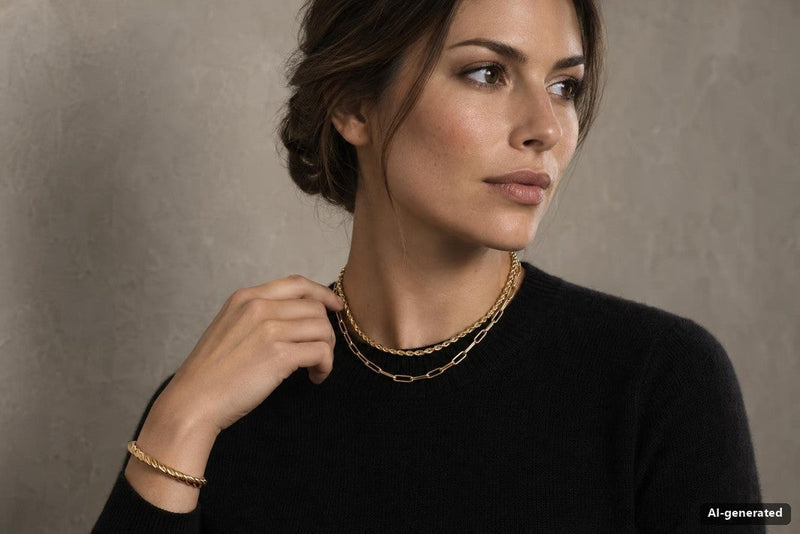
Chains show the construction well, since every link is drawn from the same bonded wire. This 2.5mm rope comes in lengths from 16 to 24 inches, and the 14/20 mark is right there in its name.

What Gold Filled Jewelry Is Made Of
Every gold filled piece has two parts. The outer layer is karat gold, most often 14K and sometimes 12K, the same kind of alloy described in our guide to 14K gold. Inside sits the core, usually jeweler's brass, an alloy of copper and zinc. Some makers use copper or sterling silver instead.
The core gives the piece its shape at a fraction of the cost of gold, and you never see it while the layer above stays intact. The color against your skin comes entirely from the karat gold. A gold filled chain looks like yellow gold because yellow gold is what you are looking at.
What separates it from plating is the order of events. The gold goes on before the jewelry exists:
-
Bond
The maker presses a sheet of karat gold onto a base metal core under heat and pressure until the two fuse. This mechanical bond is the main difference from plating, where gold settles onto a finished piece in an electric bath.
-
Roll or draw
The bonded metal goes through rollers to become thin sheet, or through a die to become wire. Gold and core thin out in proportion, so the share of gold holds steady.
-
Form
Only now does anyone make jewelry from it. Wire turns into chain links and hoops, and sheet turns into lockets and discs, each with the karat layer already in place.
Double clad means gold is bonded to both faces of the sheet, with the total weight shared between them. A 1/20 double clad sheet carries 1/40 on each side.
What 14/20 Means, Worked Out in Grams
The first number is the karat of the layer. The second says the layer makes up one twentieth of the weight of all the metal in the piece. So 14/20 is 14K gold at 1/20 by weight, and 12/20 is 12K gold at the same share.
Grams make it easier to picture. Our Link 14/20 Chain Bracelet weighs approximately 4.25 grams, which puts at least a fifth of a gram of 14K gold on its surface. Since 14K is itself 14 parts in 24, pure gold comes to about 3 percent of a 14/20 piece by weight.
That sounds slight until you set it beside plating. In the United States, the Federal Trade Commission's Jewelry Guides set the terms. Gold filled needs a mechanically bonded layer of at least 10K gold, making up at least 1/20 of the metal weight, while gold electroplate can be as thin as 0.175 microns. A micron is a thousandth of a millimeter, so that is a very thin coat indeed.
Marks you may find
14/20, 14K GF or 1/20 14K GF. Gold filled, with a 14K layer at 1/20 of the weight.
12/20 or 1/20 12K GF. The same share of gold in 12K.
RGP. Rolled gold plate, made the same way with a lighter layer of at least 1/40.
GEP. Gold electroplate, at least 0.175 microns.
HGE. Heavy gold electroplate, at least 2.5 microns.
Look on the clasp, on the small tag beside it, or inside a ring. Very small pieces such as studs may carry no stamp at all, so the product description is the place to check. A bare GF tells you the construction and leaves out the karat.
These two carry the mark in their names. The 4mm ball studs are about as simple as gold filled gets, and the bracelet is the one we just weighed.


Gold Filled, Gold Plated and Karat Gold, Side by Side
Plating and gold filled get lumped together constantly, and they should not be. Plating deposits gold on a finished piece, and our guide to gold plated jewelry explains why its thickness decides almost everything. Karat gold sits at the other end, alloyed all the way through, from 10K gold upward.
| Type | How the gold gets there | US minimum | Life with care |
|---|---|---|---|
| Gold plated | Electroplated onto brass, steel or silver | 10K, 0.175 microns | Months to a few years |
| Vermeil | Coated onto sterling silver | 10K, 2.5 microns | Years of considerate wear |
| Rolled gold plate | Bonded to a base metal core | 10K, 1/40 of the metal weight | Years, with less gold to spend than gold filled |
| Gold filled | Bonded to a base metal core | 10K, 1/20 of the metal weight | Many years, and decades with light wear |
| Karat gold | Alloyed through the whole piece | 10K, gold from surface to center | A lifetime, with service |
If you are deciding between gold filled and karat gold, we weigh the two in Gold Filled vs Solid Gold, and how to choose gold jewelry covers the wider decision.
Plating puts gold on a finished piece. Gold filled starts with the gold already there.
Where Gold Filled Earns Its Place
Earrings are the easy case. They rub against little beyond the lobe, and sizes that would get very costly in karat gold stay within reach here, so a large hoop can be a Tuesday hoop. Browse our earrings and you will see how far the range runs.
Chains come next. Layering asks for several at once, and gold filled lets you build that stack without spending as you would on one karat chain. Our picks for gold chains for daily wear go through the link styles, and how to style gold jewelry helps with the wearing.
Here are three earrings at three scales: a 22mm eurowire hoop with some presence, a 12mm endless hoop that stays close to the ear, and a 10mm open heart stud for the second piercing or the first gold gift.


How Long Gold Filled Jewelry Lasts
Because the layer is substantial, gold filled does not flake the way a thin surface finish can. With ordinary wear and sensible habits, a good chain keeps its color for many years, and pieces worn only now and then can go for decades. Gold filled watch cases from a century ago still turn up at estate sales, many with their color intact.
The limit is friction. Gold is soft, and anything that rubs all day slowly thins it. Wear shows first at the inner curve of a hoop, the loop of a clasp, and the links of a bracelet that rests on a desk while you type. Once the layer wears through, the core shows as a duller or slightly pinker patch, and that spot stays until someone replates it.
That is why bracelets and rings need the most thought. The stacking bangle here slides against its neighbors, so treat it as a piece for rotation. The 2.2mm figaro bracelet measures 6.5 inches.


Rings ask the most of the layer, since they meet every doorknob and steering wheel you touch. We would keep an everyday band in karat gold, and our wedding bands are the place to look. A gold filled stacking band worn in rotation is a different matter, and plenty of our rings suit exactly that. Texture also helps, since a woven surface hides light scuffs that a flat band would show.


Caring for Gold Filled Pieces
Warm water, a drop of mild soap and a soft cloth handle nearly everything. Rinse well and dry the piece before you put it away. Our guide on how to clean gold jewelry walks through the method, and most of it applies here.
Take gold filled off for the pool and the hot tub, because chlorine attacks gold alloys. Put on perfume and hairspray first, then the jewelry. We would skip chemical dips, ultrasonic machines and abrasive polishing cloths, all of which spend gold you cannot get back. Store each piece on its own, and the habits that prevent tarnish will cover the rest.
Sensitive Skin and Gold Filled
Your skin touches the karat gold, and many people with metal sensitivities wear gold filled comfortably for that reason. The layer is what protects you, though, so a worn patch can change things once the core is exposed. If you have a known nickel allergy, read our guide to jewelry for sensitive skin first and ask before you buy.
What a Jeweler Can and Cannot Do
Service is where gold filled gives ground. Cutting a ring to resize it breaks the layer, so most gold filled rings stay at the size you buy. Deep engraving can reach the core too, while a light inscription on a locket stays within the layer if the engraver knows what the piece is. Replating a worn spot brings the color back, but what you have afterward is a plated surface.
Resale works differently as well. A gold filled piece holds too little gold to be worth much as scrap, so buy it for the design and the years of wear. Lockets make the case nicely: they are worn for what is inside them, and an 18 inch locket necklace asks for a very different budget in karat gold.
The oval locket below carries a 0.01 ct. tw. diamond on an 18 inch chain. The bangle pairs freshwater pearls with 14K yellow gold filled metal, a good match, since pearl jewelry should see gentle wear anyway.
Featured from Sophia Jewelers
A locket and a pearl bangle, both for giving


Gold Filled Jewelry Questions
Is gold filled jewelry real gold?
The outer layer is real karat gold, usually 14K or 12K, and it makes up at least 1/20 of the metal weight. The core beneath it is another metal, usually brass, so the piece as a whole is not karat gold.
What does 14/20 mean on jewelry?
It means the outer layer is 14K gold and accounts for one twentieth of the total metal weight. You may also see it written as 1/20 14K GF or 14K GF. A 12/20 mark means the same share of gold in 12K.
Does gold filled jewelry tarnish?
The 14K surface resists tarnish far better than plated pieces or brass, though skin oils and lotion can dull it over time. Warm soapy water usually brings the color back. Discoloration that stays after cleaning often means the layer has worn through.
Can you shower with gold filled jewelry?
Water alone will not harm it, but soap film builds up and dulls the surface, so we take it off. Keep it well away from pools and hot tubs, where chlorine can attack the gold alloy.
How long does gold filled jewelry last?
With care, many years. Pieces worn only now and then can last for decades. Rings and bracelets wear fastest because they rub against the most, while earrings and necklaces usually hold their color longest.
Is gold filled better than gold plated?
For durability, yes. A gold filled layer is much thicker than standard plating and is bonded by heat and pressure, so it wears far longer. Plating usually costs less, which can suit a piece you plan to wear for a season.
Does gold filled jewelry have resale value?
Very little. It holds too little gold to be worth much as scrap, so whatever it brings later rests on the design. If resale matters to you, karat gold holds its metal value and is the better purchase.
Back to That Small Stamp
Next time you are near a window, flip over the clasp on a chain you already own. If it reads 14/20, you now know what is on it and which habits will keep it looking that way. If it reads something else, the marks above will tell you what you have.
When you are ready to add to the box, our full range of gold filled jewelry runs from small ball studs to heavy figaro chains.
Looking for your next piece?
Explore Gold Filled Jewelry →